Entry · Ref EO3KJYTS
How Autonomous Agricultural Drones Are Changing the Way We Farm
- Posted
- 2026-10-08
- Last amended
- 2026-10-08
- Account
- @lxd0clkot8
A Different Kind of Eye in the Sky
I remember the first time I watched a drone lift off from a muddy headland and climb over a field of winter wheat. The farmer next to me wasn't marvelling at the technology. He was checking his phone for the spray map. That moment stuck with me because it showed how quickly these machines have moved from novelty to necessity. We are not talking about toys or weekend hobbies. We are talking about autonomous agricultural drones, and they are rewriting the rules of crop management.
For years, farming has been a game of averages. You spread the same amount of fertiliser across a field, even though some parts need more and others need less. You spray the same pesticide mix everywhere, hoping it does the job without harming beneficial insects. Autonomous agricultural drones change that logic. They bring precision to tasks that were once blunt instruments, and they do it with a level of speed and detail that ground equipment simply cannot match.
What excites me most is not the drone itself, but what it represents. It is a shift from reacting to problems to preventing them. When you can see a stress patch in a crop weeks before it becomes visible to the naked eye, you stop playing catch-up. You start managing the field as a living system, not a uniform block of soil.
What Makes a Drone Autonomous?
True autonomy in agriculture is not just about pressing a button and watching the drone fly. It involves a stack of technologies working together. The drone uses a Global Positioning System to know where it is, but that alone is not enough. Standard GPS can be off by a metre or more, which is fine for mapping but useless for precise spraying. That is where RTK comes in. Real-time kinematic positioning corrects the signal to within a couple of centimetres, so the drone can follow the same line every pass without drifting into the crop or missing a strip.
Autopilot systems then take over. They handle takeoff, route planning, obstacle avoidance, and landing. The human operator sets the task, reviews the flight path, and monitors the mission from a tablet. If something goes wrong, the drone can return to the home point automatically or hover in place until the operator decides what to do. This is not science fiction. It is happening now on farms across the UK.
But autonomy is not just about flying. It is about decision-making. A drone equipped with multispectral imaging can measure how plants reflect light across different wavelengths. That data feeds into the Normalised Difference Vegetation Index, or NDVI, which highlights variations in plant health. A patch of crop showing low NDVI might be lacking nitrogen or suffering from water stress. The drone can then create a variable rate application map, telling the spreader or sprayer exactly how much input to apply where. That is the real power of the system.
From Observing to Acting
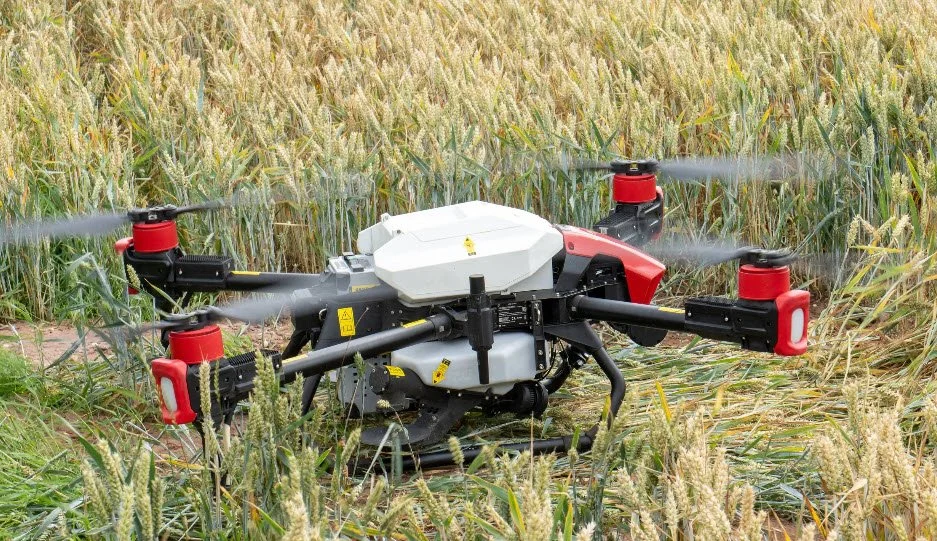
Observation is useful, but action is better. The most impressive autonomous agricultural drones are not just sensors in the sky; they are also applicators. They carry tanks and hoppers, and they can spread seeds, fertiliser, and pesticides with remarkable accuracy.
Take seeding, for example. In fields that are too wet for tractors, or in strips where you want to establish a cover crop without disturbing the soil, a drone can drop seeds precisely where they need to go. I have seen this work well on tricky slopes and in areas where conventional drills would struggle. The payload capacity is limited compared to a tractor, but the speed and flexibility more than make up for it in many situations.
Fertiliser spreading is another area where drones shine. Instead of applying a blanket rate across the whole field, you can use NDVI maps to create variable rate application. The drone adjusts the flow of granules as it moves, giving more to areas that are hungry and less to areas that are fine. This cuts waste, reduces costs, and keeps nutrients out of watercourses. It is a win for the pocket and the planet.
Pesticide spraying is perhaps the most sensitive task. Drones can apply products with a level of precision that reduces drift and avoids non-target areas. This matters near hedgerows, water bodies, and residential boundaries. The ability to hover close to the crop and apply a fine mist means less chemical ends up where it should not be.
The Tech Behind the Action
Under the skin, these machines are packed with components that would have seemed impossible twenty years ago. LiDAR, for instance, sends out laser pulses and measures how long they take to bounce back. This creates a 3D map of the terrain and obstacles, which the drone uses to adjust its height and avoid collisions. LiDAR is particularly useful in orchards and vineyards, where trees and vines create complex shapes that a simple GPS path cannot handle.
Multispectral imaging, as I mentioned, is another key piece. It captures light in several bands, including near-infrared, which is invisible to the human eye but very telling about plant health. The Normalised Difference Vegetation Index uses those bands to highlight differences in biomass and vigour. Crop health monitoring becomes a routine part of the week, not a one-off survey.
Then there is the question of who is allowed to fly these machines. In the UK, the Civil Aviation Authority regulates all drone operations, including agricultural ones. You cannot simply buy a drone and start spraying. You need to be a certified drone operator, and you need to follow strict rules about where and how you fly. This is not bureaucracy for its own sake; it is about safety, for people on the ground and for other airspace users.
One of the most talked-about developments is BVLOS, which stands for beyond visual line of sight. Most drone flights today require the pilot to keep the aircraft in view at all times. BVLOS allows the drone to fly further away, controlled from a screen, which opens up the possibility of covering much larger areas in a single mission. The CAA has been running trials, and there is real progress. But it will take time before BVLOS becomes routine for agricultural work.
Swarm Technology: Many Hands Make Light Work
If one drone is useful, what about ten? Swarm technology allows multiple drones to work together on the same field, each handling a section, coordinated by a single operator. This is where the speed advantage becomes really obvious. A single drone might cover a 20-hectare field in a morning. A swarm can do it in under an hour. The challenge is coordination. Each drone needs to know where the others are, avoid collisions, and stay within its designated area. The software is getting better, but it still requires careful planning and reliable communication.
I have seen demonstrations of swarm spraying that were genuinely impressive, but I have also seen the complexity involved. The operator needs to manage battery changes, refills, and unexpected weather. It is not a case of simply letting the drones loose. Still, the potential is enormous, especially for large arable farms where time windows for spraying are small.
Practical Considerations for Farmers
If you are thinking about using autonomous agricultural drones on your farm, there are a few things to weigh up. First, the cost. A professional spraying drone with a decent payload capacity is not cheap. You also need training, insurance, and ongoing maintenance. For many farms, it makes more sense to hire a contractor than to buy the equipment outright. That way you get the benefits without the capital outlay.
Second, the learning curve. Even though the drones are autonomous, you still need to understand the principles of flight, the software, and the regulations. A certified drone operator will have the skills and experience to handle unexpected situations. If you are new to this, it is worth shadowing someone who has done it for a season.
Third, the data. Drones generate a lot of information, and you need to know what to do with it. NDVI maps are only useful if you act on them. That means having a plan for variable rate application and the equipment to carry it out. If you are not ready to change your management practices, the drone is just an expensive camera.
Finally, consider the weather. Drones are not designed for heavy rain or strong winds. You need to pick your windows, which can be tricky in the UK. But the same is true for any sprayer, and drones are often able to work in conditions that would bog down a tractor, particularly on wet soils.
The Road Ahead
We are still in the early days of this technology, but the direction is clear. Autonomous agricultural drones will become more capable, with longer flight times and bigger payloads. BVLOS will unlock larger operations, and swarm technology will make them faster. The integration with precision agriculture tools will deepen, so that the drone becomes just one part of a connected system that includes soil sensors, weather stations, and farm management software.
For the UK farmer, this means a real chance to improve efficiency and reduce environmental impact. The days of blanket applications are numbered. The future is targeted, data-driven, and increasingly autonomous. And for those who take the time to understand it, the rewards are substantial.
I have been lucky enough to see this technology up close, and I am still struck by how far it has come in just a few years. The first drones I flew were little more than remote-controlled cameras. Now they are intelligent machines that can map, plan, and act on their own. The phrase autonomous agricultural drones may sound futuristic, but it is very much the present. The only question is how quickly we embrace it.